US Commission No. ROCE-0578
The cemetery is located in Sanislau, 3827, judet Satu Mare, 4738 2220, 285.3 miles NW of Bucharest and 16 km from Carei. Alternate name: Szaniszlo (Hungarian); Stanislau (German). Present town population is 1,000-5,000 with no Jews.
- Mayor Kovacs Jozsef, Town Hall of Sanislau, judet Satu Mare
- The Jewish Community of Satu Mare, Decebal Street no. 4A, 3900 Satu Mare, Romania, tel. 0040-61-713703
- The Federation of the Jewish Communities of Romania, Sfintu Vineri Str., no 9-11, Sector 3, Bucharest, Romania.
- "Dr. Moshe Carmilly" Institute for Hebrew and Jewish History, Universitatii Street, no. 7-9, room 61, 3400 Cluj Napoca, Romania, director: Ladislau Gyemant, This email address is being protected from spambots. You need JavaScript enabled to view it.
- Key holder and caretaker: Jewish Community from Carei, Crasnei Street no. 18
The 1880 Jewish population by census was 128, by 1900 census was 240 and in 1930 was 183. In May 1944, the Jews were gathered in the ghetto of Carei, then in that from Satu Mare and on May 19, 22, 26, 29, 30, 31, and June 1 were deported to Auschwitz. The unlandmarked Orthodox cemetery was established in second half of the 19th century. Last known burial was inter-war period.
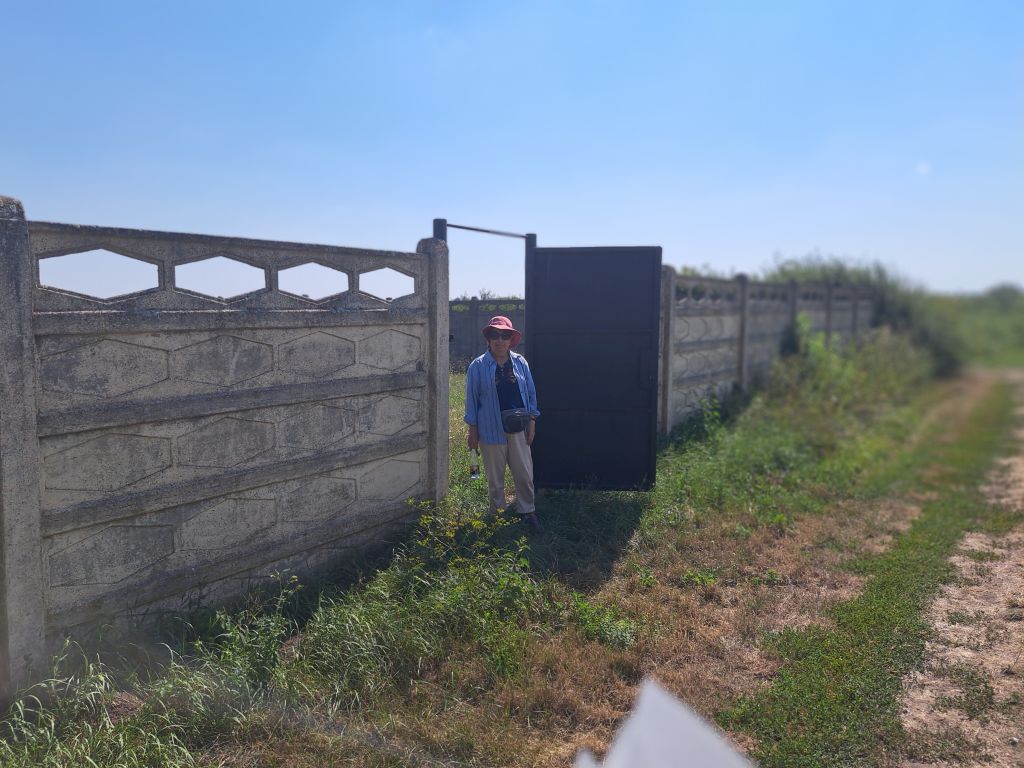
The rural/agricultural hill, separate but near other cemeteries, has no sign or marker. Reached by a public road, access is open with permission. A masonry wall with a gate that locks surrounds the site. Approximate pre-WWII size is unknown. Approximate post-WWII size is 54 x 36 m. 20-100 stones are visible, some not in original location. 25%-50% of the stones are toppled or broken. Location of stones removed from the cemetery is unknown. Vegetation overgrowth in the cemetery is a seasonal problem preventing access. Water drainage is good all year. No special sections.
The oldest known gravestone dates from second half of the 19th century. The 19th and 20th century marble, granite, limestone, sandstone, and concrete flat shaped, smoothed and inscribed, and carved relief-decorated, and double tombstones common gravestones have Hebrew inscriptions. No known mass graves.
The local Jewish community owns the property used for Jewish cemetery only. Adjacent properties are agricultural and local cemetery. Rarely, private Jewish or non-Jewish visitors stop. The never vandalized cemetery maintenance has been clearing vegetation by Jewish individuals within the country in 1998. Current care is occasional clearing or cleaning by individuals. No structures. Weather erosion is a moderate threat.
. Claudia Ursutiu, Pietroasa Str. no. 21, 3400 Cluj Napoca, Romania, tel. 0040-64-151073 visited the site and completed the survey 26 July 2000 using the following documentation:
- Recensamantul din 1880. Transilvania (1880 Transylvania Jewish Population Census.) coord.: Traian Rotariu, Cluj 1997.
- Recensamantul din 1900. (1900 Transylvania Jewish Population Census) coord.: Traian Rotariu, Cluj, 1999
- Recensamantul general al populatiei din 29 decembrie 1930 (The General Census of the Population from December 29, 1930), vol. II, Bucuresti 1938
- Recensamintul general al populatiei din Romania din 7 ianuarie 1992 (The General Census of the Population of Romania from January 7, 1992), vol. I, Bucuresti, 1994
- Zsido Lexicon, ed. by Ujvari Peter, Budapest, 1929
- Carmilly-Weinberger, Moshe. History of the Jews of Transylvania (1623-1944), Bucuresti, 1994, in Romanian
- Izvoare si marturii referitoare la evreii din Romania (Sources and Testimonies on the Jews in Romania), vol. III/1-2, coord. L. Gyemant, L. Benjamin, Bucuresti, Ed. Hasefer, 1999
- Ladislau Gyemant, This email address is being protected from spambots. You need JavaScript enabled to view it., Evreii din Transilvania in epoca emanciparii, 1790-1867 (The Jews of Transylvania in the Age of Emancipation 1790-1867), Bucuresti, ed, Enciclopedica, 2000
- Coriolan Suciu, Dictionar istoric al localitatilor din Transilvania (The Historical Dictionary of Localities in Transylvania), vol. I-II, Bucuresti, 1967
- Otto Mitelstrass, Historisch-Landeskundlicher Atlas von Siebenburgen, Ortsnamenbuch, Heidelberg, 1992
- Microsoft Auto Route Express 1999
Claudia and Adrian Ursutiu interviewed Szilagyi Maria, Sanislau. [January 2003]
Update
Sanislau is a small village several kilometers over the border from Hungary.
The Jewish cemetery is actually right outside the village and is gated. When we visited there was a lock but it was undone, so we could walk in.
When you type in Jewish cemetery, Sanislau Romania into Google maps ( better than Waze) you will get the name in Hebrew: בית החיים ר' דוד וזוגתו רחל גליק ע"ה.
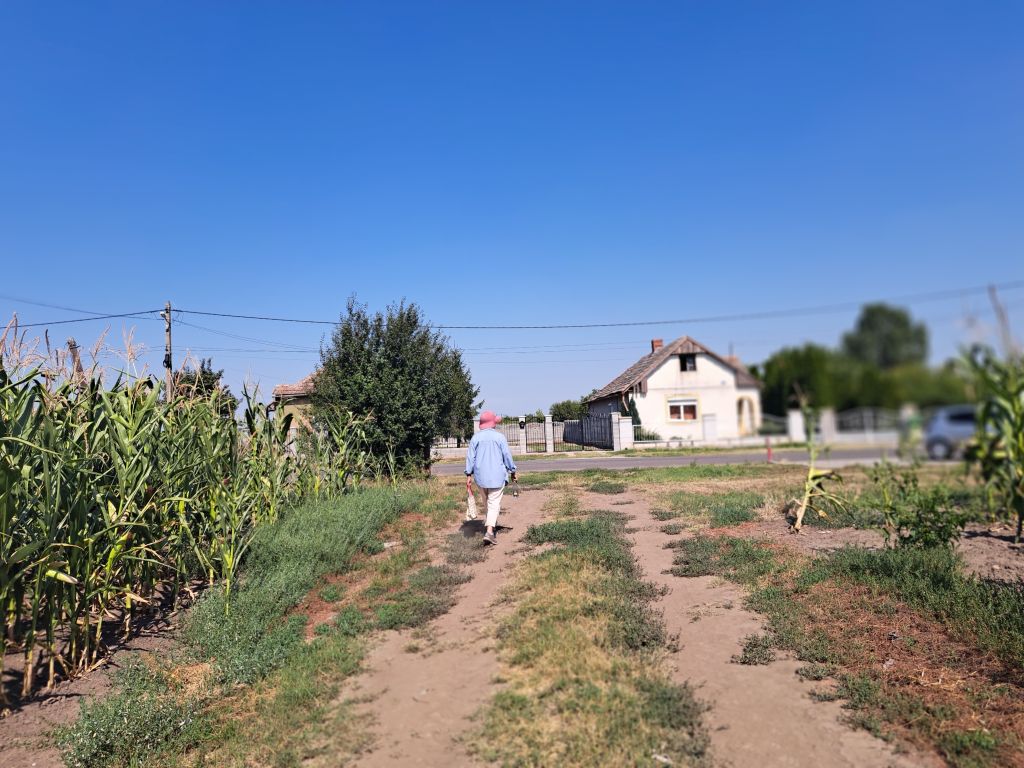
It is also in the middle of a corn field and you have to walk about 200 meters from the main road to find it. I suspect that it was much larger but farmers planted corn before the Glick family saved what little could be salvaged. There are only 5 readable stones.
Google will bring up the house which is opposite the path, so that you can find it.
I don't know who has the key but suspect that one of the people in the neighboring houses may have it.
Lynn Pollak Golumbic [August 2025]